Friday, 3 February 2012

Fight club

There has been an on-going dispute for a while between the ports of Southampton and Liverpool over the lucrative cruise industry, of which Southampton has the lion's share. Ever since Cunard moved their express liners to Southampton just after World War One, and the port since built up its passenger shipping and cruise industry, envious Scouse eyes have been cast in this direction. Liverpool can only offer its services as a port-of-call and not a turnaround port (i.e. cruises can start and finish there) because they used public money to build their terminal (Southampton port is privately funded). They are not happy about this, and have been making ever-louder noises about wanting to be a turnaround port although they have been repeatedly - and rightly - denied this because they are publicly funded. I say 'rightly' not just because I am biased but because if Liverpool can do this on the back of public money then it gives them an unfair advantage over those ports - including Southampton - who built up their trade from scratch using private money.

Liverpool offered to pay back £5 million of the tax-payers' money they used but the UK government has said 'no'. Ok, said Liverpool, we'll pay the lot back (but not, it seems the £9m of EU public funding they also got). However, according to BBC South Today, Liverpool will pay all the UK Government money back with Liverpool City Council money - also public money! This will be paid back in annual instalments, timescale unknown. What the EU will say about their money remains to be seen.

Of course, on a personal level, being a southerner and living close to Southampton, I hope that Southampton comes out on top in this dispute but, in reality, competition is no bad thing and I don't seriously think that Liverpool is going to steal all of Southampton's trade despite the fact they might want to. It's the smaller ports, such as Dover, Harwich and even Portsmouth (who are aiming for a slice of the cruise industry themselves), who will probably suffer most.
Liverpool is not in the best place for starting and ending cruises that are going to the Mediterranean or the near Continent as Southampton is closer, although Liverpool is probably better placed for cruises to Scandinavia and Greenland. Also in Southampton's favour is the double high tide, caused by the Isle of Wight which lies in the estuary, and no lock system, meaning ships can arrive and depart at any time.
Reading between the lines I believe Liverpool have their eyes on what they consider the 'big prize', the return of Cunard to their port but, frankly, I don't see that happening, not least because Cunard's (Carnival) European head office is in Southampton and they have said they have no plans to move. That said, I don't think there could be any reason why one or two Cunard cruises shouldn't depart from Liverpool during a season. I just hope that Liverpool don't think that they can grab all of Southampton's trade or try to.

Southampton (rightly) won't give up and I don't think we've heard the last of this! I think this one will run and run.

The latest news on the newest twist to the ongoing spat ~

Captain Greybeard - 'Liverpool claims victory in battle over its Pier Head Cruise terminal'
Daily Echo (Southampton) - 'Liverpool to launch turnaround cruises within months, council leader claims'
BBC - 'Liverpool settle Pier Head cruise terminal row'

---------------------------------------------------------------------------------------------------------

No photos recently, it's the depths of winter, the weather's inclement, work has got in the way and I have not managed to get out anywhere. The main website is in dire need of new material, as is this (hence the diversions taking in the Lusitania and the Southampton-Liverpool cruise spat), but hopefully once spring has got underway, the weather has improved and my current temporary job has ended, I can get out and about more. I certainly will once my seasonal job begins again.
I have a trip to Rotterdam lined up for June and am planning to join a couple of TSS cruises round the Solent.

Friday, 6 January 2012

'Lusitania - An Illustrated Biography'

April 2012 is the 100th anniversary of the sinking of a certain White Star liner on her maiden voyage. The Titanic has been the subject of countless books, articles, films, tv programmes, etc, over the years but there have been other, much more interesting ships, which have had longer lives and equally dramatic deaths but which have had nowhere near as much coverage as the Titanic. One such was the Cunard liner Lusitania of 1907, also a Victim of a Tragic and Untimely Demise but which had seven-and-a-half years of life before being on the receiving end of a torpedo from a German U-boat, which sent her to the bottom of the ocean in May 1915.

I was browsing through Amazon just after Christmas and found a book titled 'Lusitania: An Illustrated Biography' by J. Kent Layton and bought it on a whim. I don't read many books these days, as most of my reading now seems to be internet-based, but as the Lusitania is one of my three favourite liners of the past (the others are her sister Mauretania and the American liner Leviathan of 1914, the latter ship the subject of a six-volume book by the late Frank Braynard - the six volumes are superb but not holiday reading!) and the reviews were good I decided to buy this one.


It took me several evenings to read the book and it was very good, worth the £42 I paid for it (this book is also not one to take on holiday flights, it is large and heavy!). It is well-written, reads like a novel (as all well-written factual stories should), has a lot of good photos and does not dwell on her untimely end at the hands of U-20. I have read other books about the Lusitania which gloss over 7.5 years of her life in the space of a chapter before getting into the gory details of the events of 7th May 1915; this is a pity because she was an interesting ship in her own right.

Lusitania at speed. Pic from *somewhere on net!*

The book describes the building of the ship, as well as the initial problems of severe vibration which rendered the Second-class accommodation all but uninhabitable and which necessitated rebuilding and strengthening of the stern areas before Lusitania could be handed over to Cunard. Life aboard the ship is described in detail, both for the passengers and the crew (and which included some dodgy goings on!), as well as accounts of hair-raising Atlantic storms which left Lusitania battered - one smashed her bridge in, shattering the windows and pushing the entire steel bridge front back; it took her crew a while to clear up the mess and get underway again. The ship equivalent of getting your lights punched out, I suppose! The 'Lusi' and her sister, Mauretania, were 'wet' ships which dove through huge waves, rather than rode over them - this was a feature of their slim hulls, designed for speed, but meant the ships were not the most comfortable in bad weather and were damaged now and then. However, the ships were never in any real danger, even if they did get beaten up occasionally, thanks to their strong construction.
Another interesting piece of information concerns the ship's watertight divisions - in the most ironic of ironies, Lusitania (and Mauretania) would never pass today's SOLAS regulations while the Titanic would!

Another interesting thing I didn't know about Lusitania was that she had to be taken out of service for eight months from December 1912 to August 1913 for major engine repairs. She had been run at high speed continuously for a period of three weeks during 1912 to make up some lost time from strikes in Liverpool and her turbines were not allowed to cool during the very brief turnarounds in New York and Liverpool. This, and a couple of other incidents, damaged the engines badly enough that the ship needed major repairs.

As well as the story of 'Lusi's' far too brief life, the book contains lots of photos of the ship from throughout her life some of which I have seen before but a lot of which I hadn't. She was a beautiful ship, both inside and out. Times move on and, as I have said before, I am a massive fan of modern merchant ships but 'Lusi' was a very pretty ship indeed, probably the prettiest, built for speed rather than cruises, no unsightly balconies there and far more attractive than even the best-looking modern cruise ship today (yes, Queen Mary 2, I do mean you ;) ).

The book isn't about the Lusitania's premature end but, obviously, as it dealt with her life it had to deal with her death as well. As is well known, she was on the wrong end of a torpedo from U-20 on May 7th, 1915. Lusi sank in 18 minutes, along with 1198 of the 1959 people she was carrying and, unfortunately, this is what she is most known for, all these years later. Poor old Lusitania deserves better than being remembered only as a casualty of a stupid war, she had nearly eight years of happy life and this book goes a long way to portraying her as the beautiful and successful ocean liner she was, rather than as just a victim of a tragic and pointless death. As it says in the final chapter, what would she achieved if she'd survived the war and had a long life alongside her sister and fellow liners? If you're interested in ocean liners of the past, this is definitely worth a read and I think it is worth the price for the pictures alone.

Thursday, 29 December 2011

Stormy weather

For a change we decided to go over to Ventnor for a post-Christmas change of scene. The weather had become squally and unpleasant overnight, so I took my camera to get any interesting rough weather shots.

The Commodore Clipper was passing the island on her way across to Jersey and Guernsey so I took a few pictures of her in the stormy sea. I was using a 400mm lens and the weather was murky, with periodic sunbeams, as well as stormy, so they've not turned out particularly brilliantly. Very long telephotos are not ideal for taking pictures of ships simply because ships are large objects, so a 400mm is only useful for 'record shots' or 'emergencies', because atmospheric effects such as haze and mirages are more pronounced in the shots. Personally I'd rather use a smaller lens to take pictures of ships which are close by, as the quality is better.

Click for full-size.


There was a lone surfer in the waves, just off the Spyglass Inn. Usually there are a few surfers to be seen but today there was only this one. Makes me want to get my board out and do a bit of surfing, I haven't been surfing for ages.


Saturday, 17 December 2011

Saturday, 3 December 2011

'Wightlink Bunker Blues'

It is a island pastime to bash the ferry companies but, to be fair, this is not entirely undeserved by the companies themselves, with high fares and regular cancellations of sailings due to 'operational reasons'. The Hitler 'Downfall' YouTube parodies have also been done almost to death but, thanks to a link in local media recently, I found this gem on YouTube where the Führer has a rant about Wightlink. Isle of Wight residents will find this amusing and rather apt.

Saturday, 26 November 2011

QM2 video

I finally got round to adding the short videos together and have uploaded the result onto You Tube. It's not the best (slightly shaky because I forgot my tripod and held-held the camera) and there's no sound but I'm happy with it.


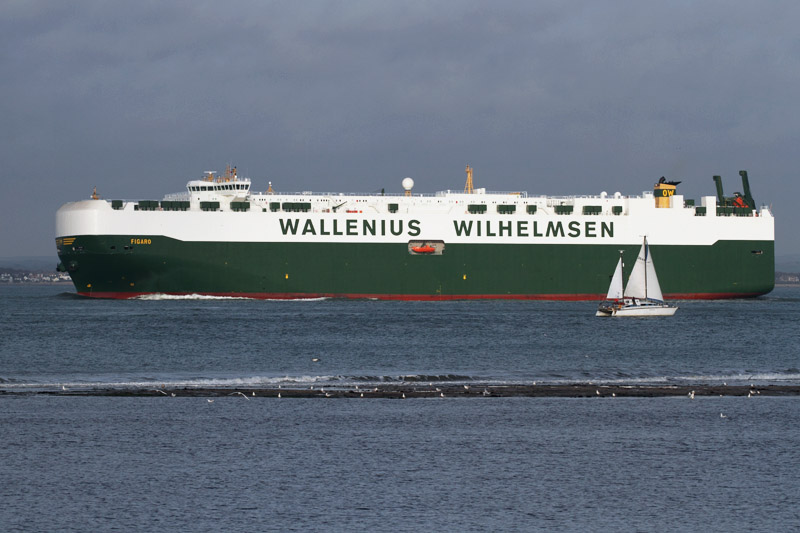
Figaro

Car carrier Figaro passing East Cowes, enroute to Southampton on 24th November 2011


Ship facts - Built: 2011; Flag: Sweden; GT: ?; IMO number: 9505041

Vehicle carriers aren't everyone's cup of tea, including mine. I am a big fan of modern merchant ships but there is definitely something of the 'floating brick' about car carriers.
Note the inevitable yacht getting in the way! I'm sure they do it on purpose...!